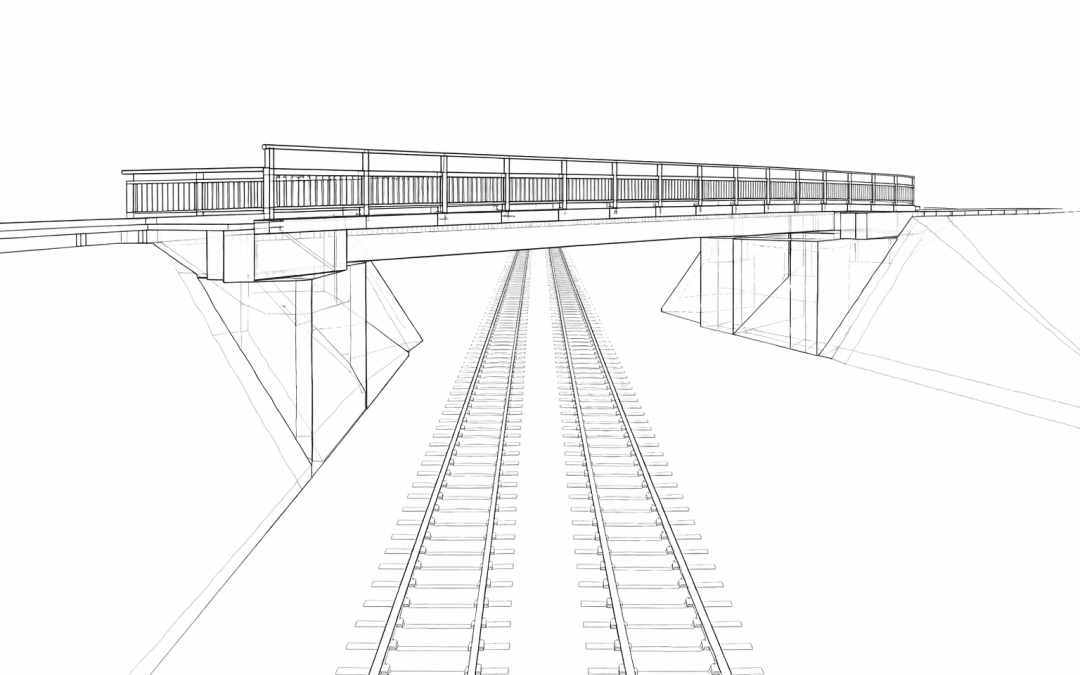
In view of the drastic cost increases for the planned Hagsfeld southern bypass, the FÜR Karlsruhe electoral group has submitted an amendment to the upcoming municipal council meeting (Tuesday, January 27). In it, city councillor Friedemann Kalmbach calls for a change of course: instead of the expensive trough solution, the bridge variant originally favored by the administration should be implemented. The aim is to secure the project financially and minimize ecological risks.
The city administration’s current draft resolution now puts the cost of the trough solution at €132.5 million – double the amount assumed in 2020 (around €70 million at the time). “In view of Karlsruhe’s historic budgetary emergency, we cannot afford to stick to a decision whose business basis has changed so dramatically,” explains City Councillor Friedemann Kalmbach.
FÜR Karlsruhe points out that a bridge solution (elevated construction) could save investment funds in the double-digit million range according to standard market estimates. As the state of Baden-Württemberg (RP) generally only subsidizes the costs of the most economical solution, the enormous additional price for the trough would probably remain almost entirely with the city of Karlsruhe. “We are threatening to spend taxpayers’ money on an aesthetically pleasing solution that we urgently need elsewhere for schools or social infrastructure,” says Kalmbach.
A central argument of the amendment is the long-term follow-up costs. While the trough causes annual costs of a predicted 3.8 million euros due to the necessary continuous operation of groundwater pumps and lighting, experience has shown that a bridge solution would cost a fraction of this amount. “A trough in the groundwater is a permanent cost driver for our earnings budget. Over a period of 30 years, we are talking about a cumulative savings potential of over 80 million euros in favor of the bridge. Deliberately accepting this burden would be unjust for the generations,” warns Kalmbach.
There are also weighty arguments in favor of the move beyond the financial aspects. The construction of a bridge does not interfere with the sensitive flow conditions of the Kinzig-Murg channel and avoids the risk of groundwater build-up. In addition, the bridge is more energy-efficient in operation (no pumps) and has a better carbon footprint during construction due to the lower use of materials. Technically, the bridge also offers the advantage of being able to be built independently of Deutsche Bahn’s timetable, which reduces the risk of delays caused by the DB corridor renovation.
FÜR Karlsruhe appeals to its colleagues on the local council to revise the 2020 decision in light of the new facts. “There is no shame in changing a plan when reality demands it. It is an imperative of economic and ecological common sense,” summarizes Friedemann Kalmbach.
FÜR Karlsruhe calls for a return to common sense – bridge instead of trough