


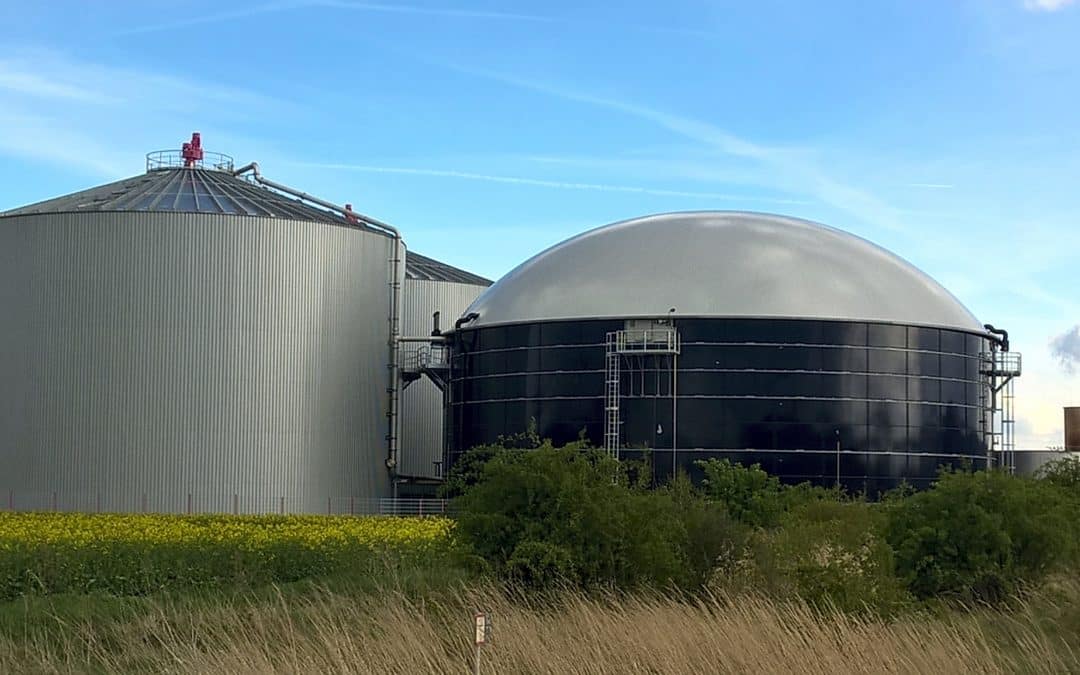
What has been on everyone’s lips since the Ukraine war was already being examined in Karlsruhe from 2009-2014 – a biogas plant that could contribute to more independent energy supply here on site.
After the parliamentary group of Freie Wähler and FÜR Karlsruhe had already pointed out in the Karlsruhe City Council that there are no dry fermentation plants in Karlsruhe and the surrounding area, the topic is now moving further and further into the public focus. Both the federal government and the state of Baden-Württemberg are increasingly drawing attention to the possibilities of recycling organic waste.
Karlsruhe’s city council has been critical of the construction of a dry fermentation plant until now, since 20,000 tons of material are needed for economically viable use and Karlsruhe can only provide about 15,000 tons. In a supplementary motion, the parliamentary group of Freie Wähler and FÜR Karlsruhe proposes the solution of building the plant together with the Karlsruhe district instead.
“We must finally make use of synergies. Especially when Karlsruhe can already provide three quarters of the minimum amount of material required.”
Councillor Friedemann Kalmbach demands
A new study by the German Biomass Research Center in Leipzig and the Wuppertal Institute, which is also mentioned in the Tagesschau, shows that with more biogas, climate-friendly energy production can replace Russian natural gas. However, it is noticeable that Karlsruhe and the surrounding area are a white spot on the map of plants when it comes to biogas production. There are none within a radius of 80 kilometers that could be used to produce biogas from biowaste. Currently, Karlsruhe’s biowaste is transported to dry fermentation plants in Flöckersheim-Wicker, 145 km away, and Bietigheim, 83 km away – a climatic and logistical challenge.
Regional use is particularly important here:
“Instead of recycling our biowaste on site, we settle for transporting it long distances with emissions. Since the last inspection of a plant in Karlsruhe, 10 years have passed and it is time to re-evaluate. Why can’t we think outside the city box and work with the county to create an on-site biogas facility that makes us more self-sufficient?”
so city councilor Jürgen Wenzel
“It has been known for a long time that biowaste is a usable raw material of natural cycles and can therefore contribute to climate-friendly energy supply. Especially in these times, when we want to emancipate ourselves from Russian gas, Karlsruhe should make its contribution. Driving our organic waste hundreds of miles away and not creating recycling opportunities in our immediate vicinity is unacceptable. With their own dry anaerobic digester, other counties would choose not to send their waste down the highways, but to recycle right in their neighborhoods”
says city councilor Petra Lorenz
In order to ensure a better power supply by biogas, the parliamentary group of the Free Voters and FOR Karlsruhe pleads for a dry fermentation plant in Karlsruhe or on a suitable area in the surrounding area of Karlsruhe, which should be served by the city and the district. In this way, Karlsruhe can produce biogas from the biowaste it generates, and the city would be taking a new step toward meeting its own energy needs in a self-sufficient manner.
