Hydrogen in Karlsruhe? At present, this energy source for replacing fossil fuels still seems a long way off for Karlsruhe’s energy transition. But there is movement in the energy carrier hydrogen. Various institutes are now researching hydrogen as an energy source, including Karlsruhe University of Applied Sciences, KIT and Fraunhofer – an initial infrastructure is being created at the Rhine port of Karlsruhe with the“H2iPort KA Mod” project in the Karlsruhe Technology Region (TRK).
Hydrogen as an energy carrier for the energy transition
The energy industry is in a state of upheaval and technological development is now racing ahead. Hydrogen hubs are being built in Baden-Württemberg, Germany is getting a hydrogen core network – Federal Minister of Economics Robert Habeck presented his plans for this in mid-November2023 . The hydrogen roadmap also includes the connection to the European hydrogen network, the so-called H2 backbone. Network operators are now inquiring about the demand for hydrogen in the municipalities and regions in order to supply them with hydrogen from 2030.
The hydrogen economy could lead the network infrastructure managed with fossil fuels from natural gas to a climate-neutral, green or blue hydrogen supply. Green hydrogen is regarded as a climate-neutral model solution produced using renewable energies. Blue hydrogen is mainly produced in Norway using the Carbon Capture and Storage (CCS) process, in which carbon dioxide (CO2) is stored underground.
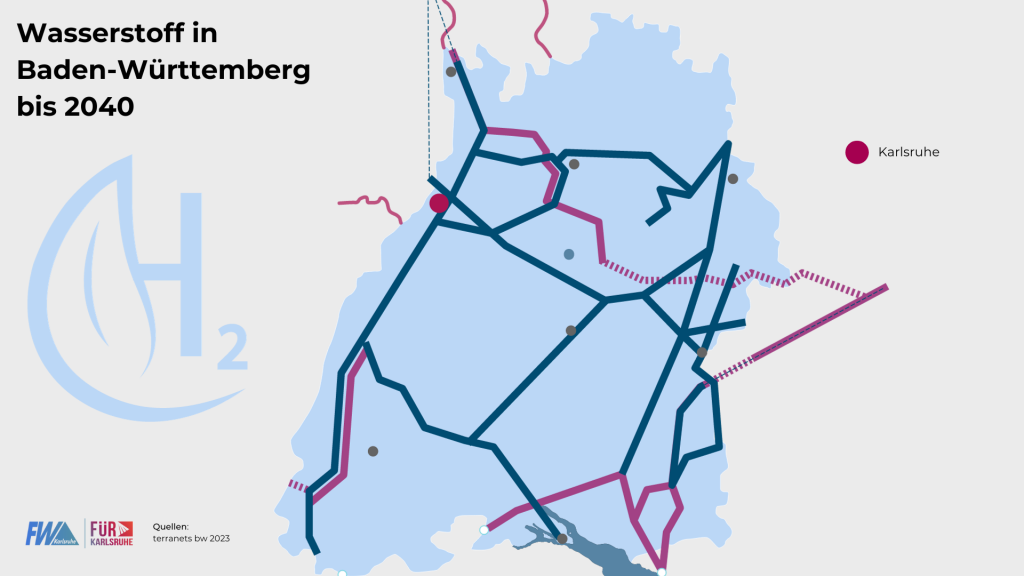
Hydrogen hub Baden-Württemberg
At the Climate Conference 2023 held in Karlsruhe, Baden-Württemberg’s Energy Minister Thekla Walker explained the information on hydrogen technologies and hydrogen storage on the H2BW platform, as well as the request for hydrogen demand via the“Hydrogen for Baden-Württemberg” website from network operator terranets bw. It also shows how companies in Baden-Württemberg could be connected via which hubs.
Research project in the Rhine port of Karlsruhe has been investigating the use of hydrogen since the end of 2022
The “H2iPort KA Mod” research project funded by the state of Baden-Württemberg was officially launched on January 1, 2023, right at the start of the year. “The aim is to develop and build a hydrogen import and production infrastructure in the pure port of Karlsruhe,” says the project sponsor. The project records the requirements arising in the Karlsruhe technology region. The demand survey can provide insights for grid expansion. For example, the connection from Karlsruhe via the hub of the German hydrogen core network in Lampertheim, which will also lead to the MiRO mineral oil refinery.
Bringing hydrogen to the city from the Karlsruhe region
At the end of November, the city of Karlsruhe adopts its energy master plan. This strategy paper for the energy transition also includes heat planning for the city – in other words, the heat supply for its citizens. Because in order to achieve the climate targets, the city must now move away from fossil fuels as quickly as possible. In Karlsruhe, there is an extensive district heating network in cooperation with the municipal utilities and MiRO, especially in the city center. However, in the outlying districts there is still no suitable option for switching efficiently from gas heating apart from the heat pump and the possibility of geothermal energy, which is still to be examined and is also struggling with acceptance problems in Neureut, and geothermal probes. In these locations, where heat pumps are not possible for structural reasons and due to noise emissions, and where district heating or a local heating network is not available, an alternative must be found (see our position paper). This alternative could mean hydrogen in the existing gas grid infrastructure. Industry and research now indicate that this is possible. Hydrogen and fuel cell technologies enable, for example already operating a gas heating system with H2-ready boilers. The changeover costs only a fraction of the cost of a complete changeover. The proportion of hydrogen could thus increase in the coming years until distribution and import are in widespread use. In addition, there are options such as the use of biomass in a biogas plant in the district of Karlsruhe, which our group has called for.
Needs assessment must be carried out now
To avoid making a mistake now, our city council groups have requested that hydrogen network expansion areas for the heating transition be included in the energy master plan. Because if the city does not report its needs for the future to a sufficient extent, the connection will also be slower – because priority is given to those municipalities that show that they are willing and able to meet actual needs.
Find out more: You can download all the details in our position paper on the energy master plan here.